
Herb comparison
Caraway (Carum carvi) vs German Chamomile (Chamomilla recutita)
Both plants are listed as traditional remedies for 1 of the same condition, which is why they are easy to confuse. Their descriptions and full safety notes are below, free.

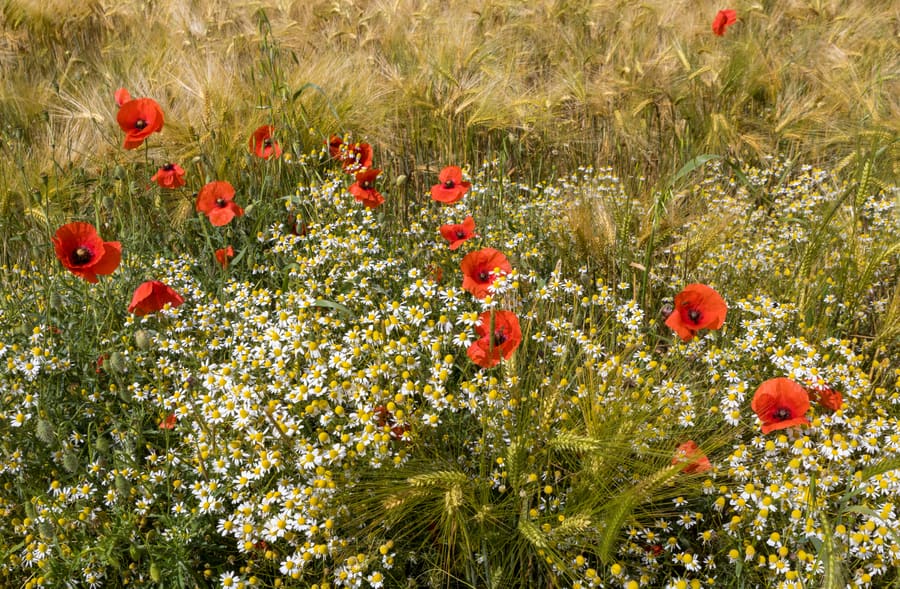
- About
- Caraway is an aromatic annual herb growing to 2 feet with a ridged stem, feathery leaves, and umbels of white flowers in midsummer. Exploding capsules release two small narrow seeds. It grows wild in Europe, North Africa, and Asia, preferring sunny sites up to 6,600 feet above sea level. Cultivated in Europe, Russia, North Africa, and the United States, the seeds are harvested ripe in late summer. The seeds are commonly used in cooking.German chamomile (Matricaria recutita) is a sweetly aromatic annual, growing to about 2 ft (60 cm), featuring finely cut leaves and small, daisy-like flower heads with white petals and a yellow center. It has a slightly bitter, apple-like taste. It is promoted today for indigestion, anxiety, insomnia and other conditions and used on the skin for some skin conditions; NCCIH says studies have not produced enough reliable evidence to rate its usefulness for specific conditions.
- Safety & precautions
- Do not use the essential oil internally except under professional supervision.Allergies: Some individuals may experience allergic reactions (e.g., dermatitis) more often than with many other herbs. Essential Oil: Avoid internal use unless professionally supervised; do not use topically during pregnancy. Blood-Thinning Medications: Seek professional guidance if also taking anticoagulants. Children: Ask a professional before giving it to children.
Safety text above is printed in full and is never abbreviated. For each plant’s complete precautions, drug and food interactions and preparation notes, open its own page - both are free.
Conditions that list both
Related comparisons
- Caraway (Carum carvi) vs Catnip (Nepeta cataria)
- Caraway (Carum carvi) vs Dill (Anethum graveolens)
- Caraway (Carum carvi) vs Oregano (Origanum vulgare)
- Caraway (Carum carvi) vs Peppermint (Mentha x piperita)
- Caraway (Carum carvi) vs White Horehound (Marrubium vulgare)
- Caraway (Carum carvi) vs Cramp Bark (Viburnum opulus)