
Herb comparison
Caraway (Carum carvi) vs Oregano (Origanum vulgare)
Both plants are listed as traditional remedies for 2 of the same conditions, which is why they are easy to confuse. Their descriptions and full safety notes are below, free.

- About
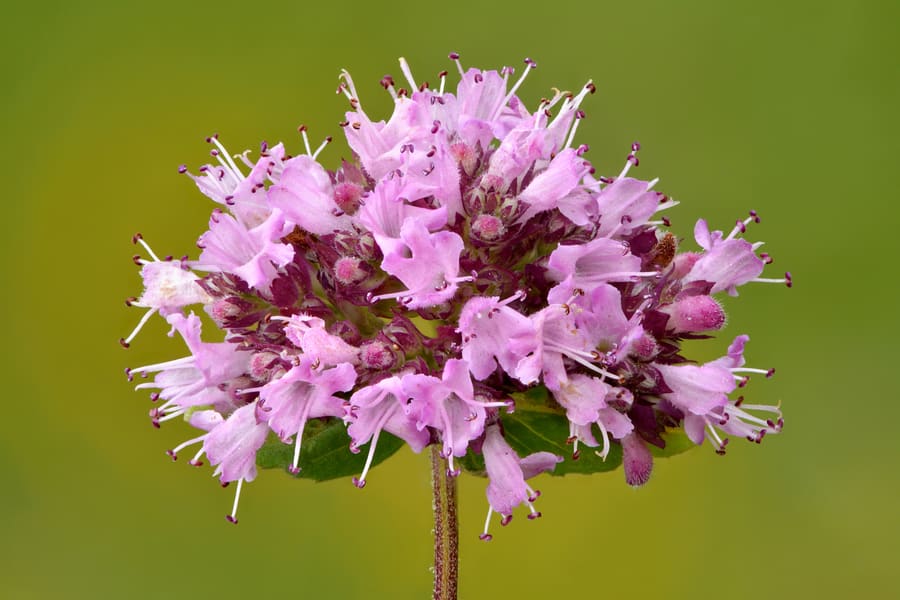
- Caraway is an aromatic annual herb growing to 2 feet with a ridged stem, feathery leaves, and umbels of white flowers in midsummer. Exploding capsules release two small narrow seeds. It grows wild in Europe, North Africa, and Asia, preferring sunny sites up to 6,600 feet above sea level. Cultivated in Europe, Russia, North Africa, and the United States, the seeds are harvested ripe in late summer. The seeds are commonly used in cooking.Oregano (Origanum vulgare) is an upright perennial up to around 32 in (80 cm), bearing square red stems, elliptical leaves, and clusters of deep pink flowers. Strongly aromatic, oregano is a widely used culinary herb.
- Safety & precautions
- Do not use the essential oil internally except under professional supervision.Pregnancy: Avoid in large amounts due to possible uterine stimulation. Essential Oil: Toxic to the liver when taken internally; external use must be diluted. Skin Irritation: Potentially irritating topically.
Safety text above is printed in full and is never abbreviated. For each plant’s complete precautions, drug and food interactions and preparation notes, open its own page - both are free.
Conditions that list both
Related comparisons
- Caraway (Carum carvi) vs Catnip (Nepeta cataria)
- Caraway (Carum carvi) vs Dill (Anethum graveolens)
- Caraway (Carum carvi) vs Peppermint (Mentha x piperita)
- Caraway (Carum carvi) vs White Horehound (Marrubium vulgare)
- Oregano (Origanum vulgare) vs Triphala (Terminalia chebula blend)
- Oregano (Origanum vulgare) vs White Horehound (Marrubium vulgare)