
Herb comparison
Boldo (Peumus boldus) vs Irish Moss (Chondrus crispus)
Both plants are listed as traditional remedies for 2 of the same conditions, which is why they are easy to confuse. Their descriptions and full safety notes are below, free.
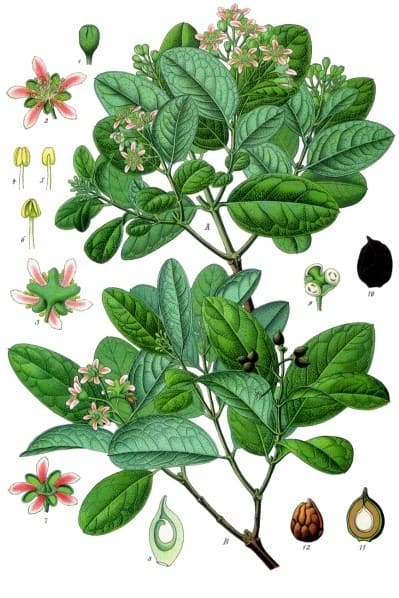
Boldo (Peumus boldus) is restricted
Preparation amounts are not shown for this herb. It is toxic, restricted, or otherwise unsafe to self-dose - the margin between a traditional dose and a harmful one is too small to publish as reference material. If you are considering it, that conversation belongs with a doctor or a qualified practitioner, not a website.
- About
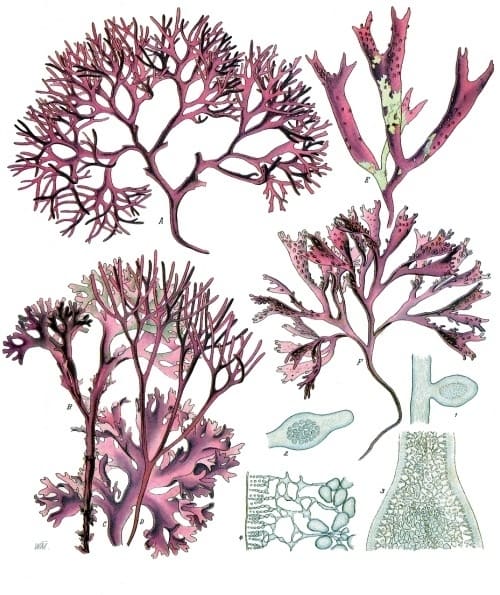
- Boldo is a strongly aromatic multi-branched evergreen shrub or tree growing to 20 feet. It has egg-shaped leathery leaves with a lemony scent, clusters of white or yellow bell-shaped flowers, and small yellow berries. Native to Chile and Peru, it has become naturalized in the Mediterranean region and the West Coast of North America, where it grows on dry sunny slopes and in mountain pastures in the Andes. It is widely cultivated, and its leaves are gathered throughout the year.Irish moss is a reddish-brown seaweed growing to 10 inches, with a flat, forked plant body and fan-shaped outline. Found on the Atlantic coasts of Europe and North America, it grows just below the waterline, attached to rocks and stones. In summer in North America and in autumn in Ireland, it is pulled up by hand or with a rake at low tide and dried in the sun. This seaweed is used extensively in the food and pharmaceutical industries as an emulsifying and binding agent, appearing in products such as toothpastes. Its polysaccharides become jelly-like when immersed in water, which makes it useful as a food ingredient.
- Safety & precautions
- Do not take during pregnancy. Subject to legal restrictions in some countries due to the presence of ascaridole, a toxic constituent in the volatile oil. The dose and duration of treatment should be restricted to minimize risk. If you take a blood thinner or any other prescription medicine, ask a pharmacist before using boldo.Due to its blood-thinning property, Irish moss should not be used by people taking anticoagulant medicines.
Safety text above is printed in full and is never abbreviated. For each plant’s complete precautions, drug and food interactions and preparation notes, open its own page - both are free.
Conditions that list both
Related comparisons
- Boldo (Peumus boldus) vs Fringe Tree (Chionanthus virginicus)
- Boldo (Peumus boldus) vs Triphala (Terminalia chebula blend)
- Bacopa (Bacopa monnieri) vs Irish Moss (Chondrus crispus)
- Boldo (Peumus boldus) vs Milk Thistle (Silybum marianum)
- Agrimony (agrimonia eupatoria) vs Boldo (Peumus boldus)
- Barberry (Berberis vulgaris) vs Boldo (Peumus boldus)